Still Tracking Your Stack in a Spreadsheet?
You paste in spot prices. You maintain a weights table for junk silver. You fix the formula that broke three columns over. There is a better way, and it keeps your data just as private as the file on your own machine.
Every stacker starts with a spreadsheet
At first it is simple. A few coins, a column for what you paid.
Then you add silver. Then junk silver, and now you need a weights table. Then Goldbacks, which are a different math entirely. Then a second worksheet. Then formulas referencing other formulas. Then you are pasting in spot prices by hand every time you want a real number.
Then one broken formula quietly throws your totals off, and you do not notice for a month.
The spreadsheet did not fail because you built it wrong. It failed because it was never designed to manage a growing precious metals portfolio. At some point the upkeep becomes a chore you avoid, and a stack you stop tracking.
The same job, two very different amounts of work
You give up the manual work, not the privacy.
You do not have to retype everything
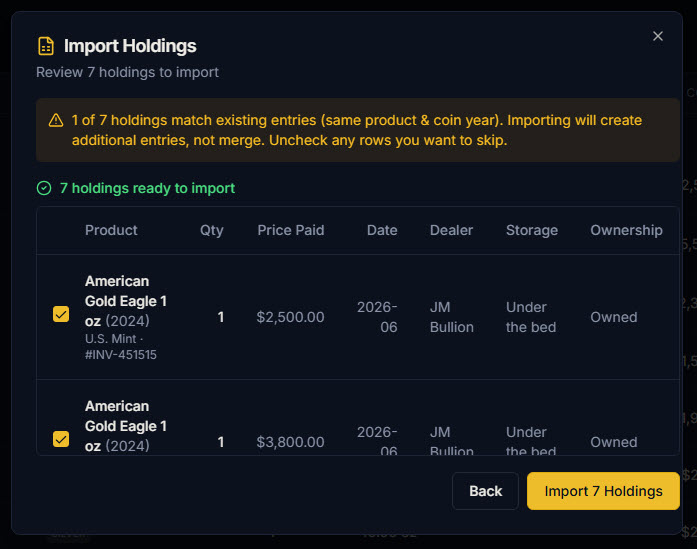
Leaving a spreadsheet does not mean re-entering years of records one by one. MyOunces takes a CSV import, so you can move your data over in bulk. Download the import template, line your data up to it, and bring the whole stack in at once.
It is not a one-click drop of your raw file, you do format it to match, but it beats typing every coin into a form.
And you are never locked in. Export to CSV or JSON anytime. Keep your old spreadsheet as long as you want. MyOunces is a better place to keep the data, not a trap for it.
Line by line, by hand or done for you
| Feature | Spreadsheet | MyOunces |
|---|---|---|
| Spot prices | You look them up and paste them in | Live, updates on their own |
| Melt value | You write the formula | Calculated automatically |
| Junk silver | You maintain a weights table | Enter face value, done |
| Product weights and purity | You research and type each one | Built in |
| A new coin type | New row, new formulas | Pick it from the list |
| Cost basis and gain/loss | You build the columns | Already there |
| Allocation by metal | You make the chart | Live chart |
| Currency | One, unless you build conversion | 9, switch any time |
| Data privacy | Private (on your machine) | Private (stays on your device) |
The last row is the one most people miss. A spreadsheet is private because it sits on your machine. MyOunces keeps exactly that. No account, no cloud, your data on your device. You trade the manual work, not the privacy.
A spreadsheet stores numbers. This shows you what they mean.
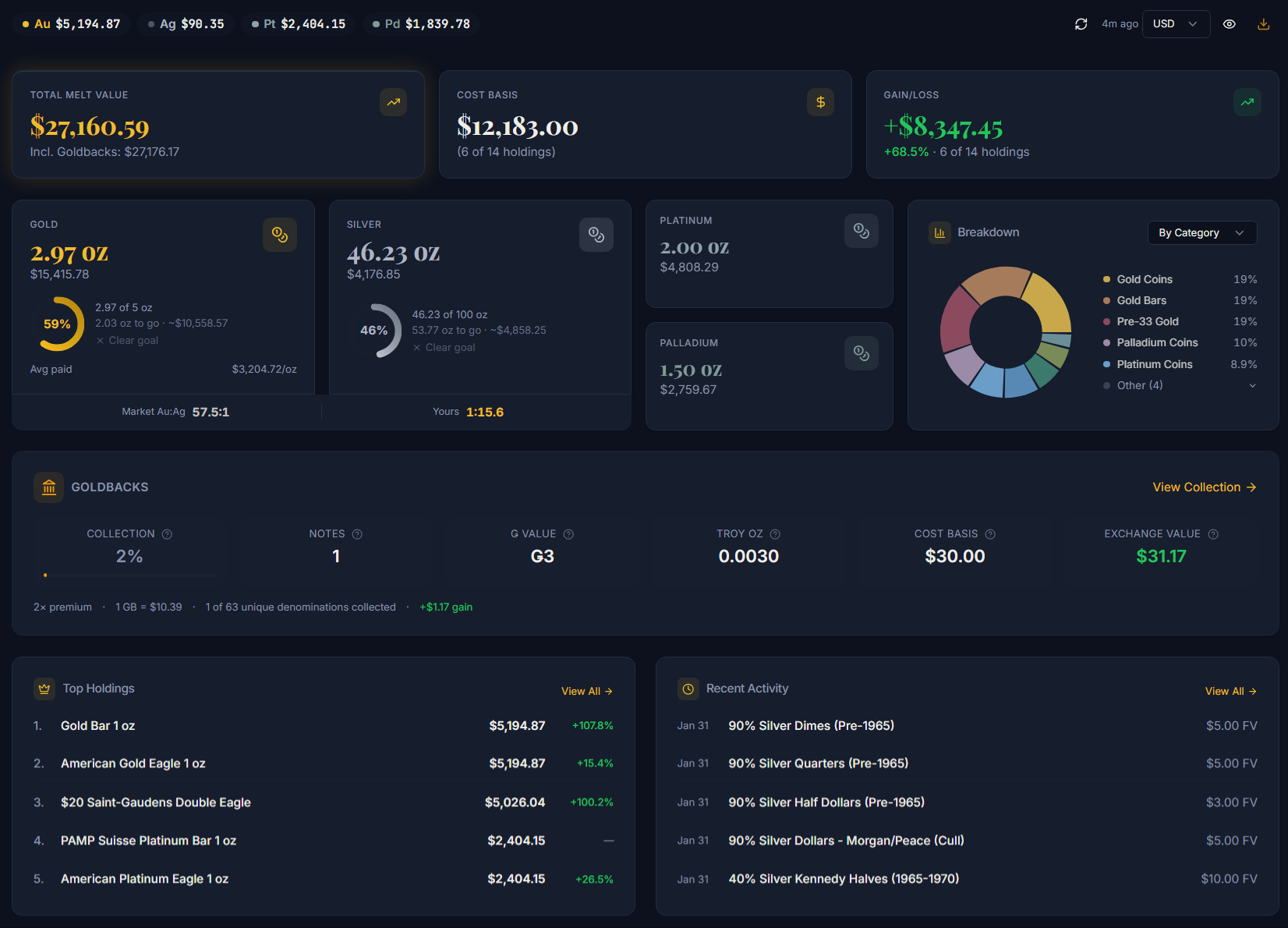
Because the data is structured and the prices are live, MyOunces can show you things a spreadsheet would make you build by hand: your allocation across metals, your gain or loss since you bought, and your progress toward an ounce goal.
The same records you were keeping, now actually telling you something.
You keep the one thing the spreadsheet got right
A lot of stackers use a spreadsheet precisely because it does not phone home. No account, no company holding your inventory. MyOunces is built the same way. Your holdings live in your browser's local storage, on your device, never sent to a server. Your backup is a file you hold yourself, the way you hold the spreadsheet now.
Want the full breakdown of how the privacy architecture works? How the privacy architecture works →
When a spreadsheet is actually fine
Here is the honest version. If you own two Silver Eagles and a Maple, a spreadsheet is perfectly fine. You do not need software for three coins.
It changes as the stack grows. Once you are tracking dealers, storage locations, premiums over melt, tags, goals, and a mix of metals and junk silver, the spreadsheet stops saving you time and starts costing it.
That is the point where MyOunces pays for itself. If you are reading this far, you are probably already there.
| MyOunces | Spreadsheet | |
|---|---|---|
| Live spot prices | ||
| Automatic melt value | You build it | |
| Catalog with weights and purities | You maintain it | |
| Junk silver by face value | You calculate it | |
| Cost basis and gain/loss | Built in | You build it |
| Data stays on your device | ||
| No account, no cloud | ||
| Cost | $79 once | Free, but it costs you hours |
Free costs you time. $79 buys it back.
Start free. Upgrade once when you are ready. No subscription, ever.
Pro
$79
one time
- Unlimited products
- Every feature, including the Intelligence Hub
- Use on up to 5 devices
- One payment, yours forever
$79 once. No subscription. Bulk import included.
Frequently asked questions
Close the spreadsheet. Keep the privacy.
Bulk import your data. No account, no cloud.