How to Calculate Junk Silver Value: The Complete Guide
By Justin · Published · Updated
Junk silver isn't junk at all. Here's how to calculate exactly what your pre-1965 US silver coins are worth based on their actual silver content.
What Is Junk Silver?
Junk silver refers to US coins minted before 1965 that contain 90% silver. The term "junk" is misleading. It doesn't mean the coins are worthless. It means they have no collectible or numismatic premium above their silver content.
These coins are also called "constitutional silver" because they were minted under the original specifications of US coinage law.
Junk silver includes dimes, quarters, half dollars, and dollars dated 1964 or earlier. After 1964, the US Mint switched to copper-nickel clad coins with no silver content (with a few exceptions we'll cover below).
Stackers buy junk silver because it offers a low-premium way to acquire physical silver in small, recognizable, divisible units. A dime contains a small amount of silver. A half dollar contains more. You can buy and sell in whatever increments you need.
The Simple Formula
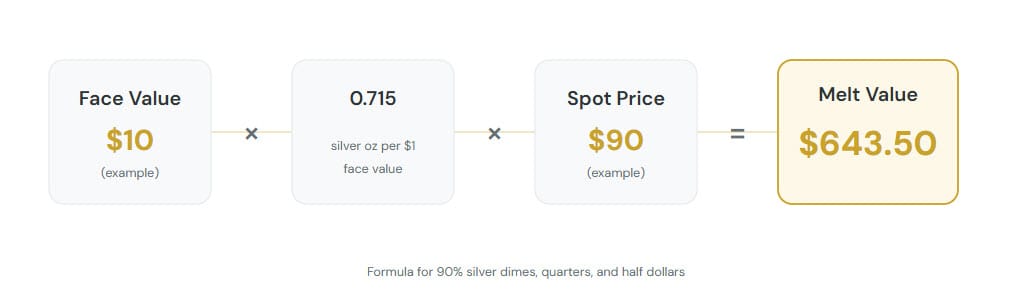
For 90% silver dimes, quarters, and half dollars, the calculation is straightforward:
Face Value × 0.715 × Spot Price = Melt Value
That's it. Multiply your total face value by 0.715, then multiply by the current silver spot price.
The 0.715 represents the troy ounces of pure silver in each dollar of face value. So if you have $10 face value in quarters (40 quarters), you have approximately 7.15 troy ounces of silver.
Example: You have $10 face value in mixed 90% silver coins. Silver spot price is $90 per ounce.
$10 × 0.715 × $90 = $643.50
Use our live calculators for instant results: $1 face value junk silver, $10 face value junk silver, and $100 face value junk silver.
Your coins contain about $643 worth of silver at that spot price.
Why 0.715 and Not 0.723?
When these coins left the mint, each dollar of face value contained 0.7234 troy ounces of pure silver. That's the original specification.
But these coins circulated for decades. Handling, counting, and general wear slowly removed tiny amounts of silver from each coin. The industry standard assumes circulated coins have lost a small percentage of their original silver content.
Most dealers use 0.715 as the multiplier for average circulated junk silver. Some use 0.71 for heavily worn coins or 0.72 for coins in better condition. For most calculations, 0.715 is the accepted standard.
Silver Content by Coin Type
Not all junk silver is the same. Here's exactly how much silver is in each type of coin.
90% Silver Coins (1964 and Earlier)
These are the classic junk silver coins. All contain 90% silver and 10% copper.
Dimes
| Coin | Years Minted | Silver Content |
|---|---|---|
| Roosevelt Dime | 1946-1964 | 0.0723 oz |
| Mercury Dime | 1916-1945 | 0.0723 oz |
| Barber Dime | 1892-1916 | 0.0723 oz |
See the 90% silver dime melt value calculator for live pricing.
Quarters
| Coin | Years Minted | Silver Content |
|---|---|---|
| Washington Quarter | 1932-1964 | 0.1808 oz |
| Standing Liberty Quarter | 1916-1930 | 0.1808 oz |
| Barber Quarter | 1892-1916 | 0.1808 oz |
"See the 90% silver quarter melt value calculator for live pricing.
Half Dollars
| Coin | Years Minted | Silver Content |
|---|---|---|
| Kennedy Half Dollar | 1964 only | 0.3617 oz |
| Franklin Half Dollar | 1948-1963 | 0.3617 oz |
| Walking Liberty Half Dollar | 1916-1947 | 0.3617 oz |
| Barber Half Dollar | 1892-1915 | 0.3617 oz |
"See calculators for the 1964 Kennedy Half Dollar, Walking Liberty Half Dollar, and Franklin Half Dollar.
Silver Dollars
| Coin | Years Minted | Silver Content |
|---|---|---|
| Morgan Dollar | 1878-1921 | 0.7734 oz |
| Peace Dollar | 1921-1935 | 0.7734 oz |
Important: Silver dollars contain MORE silver per dollar of face value than smaller coins. A Morgan or Peace dollar has 0.7734 oz of silver, not 0.715 oz. This is why silver dollars are typically priced individually rather than by face value.
40% Silver Coins (1965-1970)
When silver prices rose in the mid-1960s, the US Mint reduced the silver content of half dollars to 40%.
| Coin | Years Minted | Silver Content |
|---|---|---|
| Kennedy Half Dollar | 1965-1970 | 0.1479 oz |
| Bicentennial Half Dollar (S mint) | 1976-S | 0.1479 oz |
Note: Only 1976 half dollars with the "S" mint mark contain silver. Regular 1976 halves from Philadelphia and Denver are copper-nickel clad with no silver.
Formula for 40% halves: Number of coins × 0.1479 × Spot Price = Melt Value
35% Silver War Nickels (1942-1945)
During World War II, nickel was needed for the war effort. The US Mint temporarily replaced nickel with silver in five-cent coins from 1942 to 1945.
| Coin | Years Minted | Silver Content |
|---|---|---|
| Jefferson "War" Nickel | 1942-1945 | 0.0563 oz |
How to identify war nickels: Look for a large mint mark (P, D, or S) above Monticello on the reverse. Regular nickels have small or no mint marks on the side of the coin. War nickels have an oversized mint mark on top of the building.
Important: Not all 1942 nickels are silver. The Mint produced both regular and silver nickels that year. Only 1942 nickels with the large mint mark above Monticello contain silver.
Formula for war nickels: Number of coins × 0.0563 × Spot Price = Melt Value
How to Identify Junk Silver
Not sure if your coins are silver? Here's how to tell.
Check the date. Any dime, quarter, or half dollar dated 1964 or earlier is 90% silver. Kennedy halves dated 1965-1970 are 40% silver. Anything 1971 or later (with rare exceptions) contains no silver.
Check the edge. Silver coins have a solid gray/silver edge. Modern clad coins have a visible copper stripe running through the edge. If you see copper, it's not silver.
For war nickels, check the mint mark. Look at the reverse (Monticello side). If there's a large letter above the dome of the building, it's a silver war nickel. If the mint mark is small and on the right side of the building, or absent entirely, it's a regular nickel with no silver.
Weigh it. Silver coins are slightly heavier than their clad counterparts due to silver's density. A silver dime weighs 2.5 grams versus 2.27 grams for a clad dime.
Standard Quantities: Rolls and Bags
Junk silver is commonly sold in standard quantities. Here's what each contains.
Rolls
| Roll Type | Face Value | Number of Coins | Silver Content |
|---|---|---|---|
| Dimes | $5 | 50 coins | 3.575 oz |
| Quarters | $10 | 40 coins | 7.15 oz |
| Half Dollars (90%) | $10 | 20 coins | 7.15 oz |
| Half Dollars (40%) | $10 | 20 coins | 2.958 oz |
| War Nickels | $2 | 40 coins | 2.25 oz |
Bags
| Bag Size | Silver Content | Approximate Weight |
|---|---|---|
| $100 face | 71.5 oz | ~5.5 lbs |
| $500 face | 357.5 oz | ~27.5 lbs |
| $1,000 face | 715 oz | ~55 lbs |
A $1,000 face value bag is roughly the size of a football and weighs about 55 pounds total (coins plus silver).
Calculate current value for any bag size using our $100 face value junk silver calculator.
Worked Examples
Let's walk through some real calculations.
Example 1: Three rolls of Washington quarters
You have 3 rolls of pre-1964 Washington quarters. Each roll is $10 face value.
Total face value: $10 × 3 = $30 Silver content: $30 × 0.715 = 21.45 oz At $90 spot: 21.45 × $90 = $1,930.50
Example 2: Mixed coins from a collection
You inherited a small collection: 12 Mercury dimes, 8 Walking Liberty half dollars, and 5 Washington quarters.
Dimes: 12 × $0.10 = $1.20 face value Halves: 8 × $0.50 = $4.00 face value Quarters: 5 × $0.25 = $1.25 face value Total: $6.45 face value
Total: $6.45 face value Silver content: $6.45 × 0.715 = 4.61 oz At $90 spot: 4.61 × $90 = $414.95
Example 3: 40% Kennedy halves
You have 35 Kennedy half dollars dated 1965-1970.
Silver content: 35 × 0.1479 = 5.18 oz At $90 spot: 5.18 × $90 = $466.02
Example 4: War nickels
You found a roll of 40 war nickels.
Silver content: 40 × 0.0563 = 2.25 oz At $90 spot: 2.25 × $90 = $202.68
Silver Dollars Are Different
Morgan and Peace silver dollars don't follow the 0.715 rule. Each dollar contains 0.7734 troy ounces of silver, which is more than $1 face value in smaller coins (0.715 oz).
This means 10 silver dollars contain 7.734 oz of silver, while $10 face value in dimes (100 dimes) contains only 7.15 oz.
Silver dollars also typically carry higher premiums than junk silver because of collector demand. They're usually priced per coin rather than by face value.
Formula for silver dollars: Number of coins × 0.7734 × Spot Price = Melt Value
Common Mistakes to Avoid
Using regular ounces instead of troy ounces. Precious metals are always measured in troy ounces (31.1 grams), not standard ounces (28.35 grams). If you're weighing coins, make sure your scale is set to troy ounces or grams.
Applying the 0.715 multiplier to 40% halves. The 0.715 multiplier only works for 90% silver. For 40% Kennedy halves, use 0.1479 oz per coin.
Assuming all 1942 nickels are silver. Only 1942 nickels with the large mint mark above Monticello contain silver. The Mint produced both types that year.
Forgetting about wear. Heavily worn coins may contain slightly less silver than the standard calculations assume. The 0.715 multiplier already accounts for average wear, but extremely worn coins may fall short.
Confusing face value with silver value. A silver quarter has a face value of $0.25 but contains around $5-7 worth of silver at typical spot prices. Never spend junk silver at face value.
Tracking Your Junk Silver
If you're accumulating junk silver over time, tracking your holdings can get complicated. Different coin types, different silver contents, constantly changing spot prices.
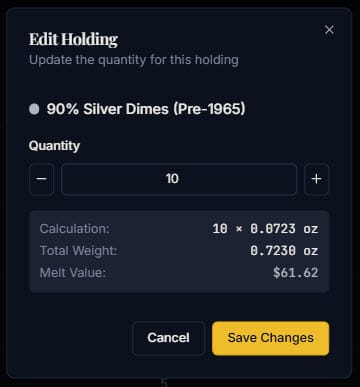
MyOunces has a built-in junk silver calculator that handles all of this automatically. Enter your coins by face value or roll count, and it calculates the melt value in real time based on current spot prices.
Frequently Asked Questions
How much silver is in $1 face value of junk silver?
For 90% silver dimes, quarters, and half dollars, $1 face value contains approximately 0.715 troy ounces of pure silver. Silver dollars contain 0.7734 oz each.
What is 90% junk silver worth right now?
Multiply the current silver spot price by 0.715 to get the melt value per dollar of face value. Check current spot prices online or use a junk silver calculator.
Are silver dollars included in the 0.715 formula?
No. Morgan and Peace dollars contain 0.7734 oz of silver each. Use the formula: Number of coins × 0.7734 × Spot Price.
How do I calculate the value of war nickels?
Each war nickel (1942-1945 with large mint mark) contains 0.0563 oz of silver. Multiply the number of coins by 0.0563, then multiply by the spot price.
What's the difference between 90% and 40% silver?
90% silver coins (pre-1965) contain 90% silver and 10% copper. 40% silver Kennedy halves (1965-1970) contain 40% silver with a copper-nickel core. The 40% coins have significantly less silver per coin.
Is junk silver a good investment?
Junk silver offers low premiums over spot, high divisibility, and instant recognition. It's a popular choice for stackers who want physical silver without paying high premiums for bullion coins. Whether it's right for you depends on your goals.
Quick Reference Cheat Sheet
90% Silver (dimes, quarters, halves pre-1965):
- Face Value × 0.715 × Spot Price = Melt Value
- Dime: 0.0723 oz | Quarter: 0.1808 oz | Half: 0.3617 oz
Silver Dollars (Morgan, Peace):
- Number of coins × 0.7734 × Spot Price = Melt Value
40% Silver (Kennedy halves 1965-1970):
- Number of coins × 0.1479 × Spot Price = Melt Value
35% Silver War Nickels (1942-1945):
- Number of coins × 0.0563 × Spot Price = Melt Value
This article is for educational purposes only and does not constitute financial advice. Always verify current spot prices before buying or selling.