The Complete Constitutional Silver Guide: Every Coin, Every Year, Every Formula (2026)
By Justin · Published · Updated
A note on terminology: "Junk silver" and "constitutional silver" mean the same thing: US coins minted before 1965 that contain 90% silver. The term "junk" isn't derogatory; it simply means these coins have no numismatic premium beyond their silver content. "Constitutional" refers to Article I, Section 8 of the US Constitution, which granted Congress the power to coin money. We'll use both terms interchangeably.
If you've ever tried to figure out exactly how much silver is in your grandfather's coin jar, you know the frustration. Different coins, different years, different purities. Some calculators only do US coins. Others make you look up silver content for each coin type separately.
So I built a calculator that handles everything: US 90%, US 40%, war nickels, Canadian 80%, Canadian 50% transition coins, all with live spot prices and automatic face value conversion. This guide is the reference I wished existed when I started stacking.
What Is Constitutional Silver?
Constitutional silver refers to US coins minted before 1965 that contain 90% silver and 10% copper. The Coinage Act of 1965 eliminated silver from dimes and quarters entirely and reduced the half dollar from 90% to 40% silver. By 1970, silver was removed from all circulating US coinage.
These coins are called "junk silver" because they trade based purely on silver content. No collector premium, no grading, no special packaging. A worn 1942 Washington quarter and a shiny 1964 Washington quarter contain the same amount of silver and trade at the same price.
Why stackers love junk silver:
- Instantly recognizable. Everyone knows what a quarter looks like.
- Impossible to counterfeit. US coins have security features built in over decades.
- Fractional by nature. Small denominations for barter or small purchases.
- No fabrication premium. You're buying silver that already exists.
- Legal tender. Still spendable at face value (though you'd be crazy to do it).
- Historical connection. These coins actually circulated as money.
The Three Purities of US Junk Silver
Not all junk silver is created equal. US coins come in three silver purities:
90% Silver (Pre-1965)
The standard. Dimes, quarters, half dollars, and dollars minted 1964 and earlier contain 90% silver and 10% copper. This is what most people mean when they say "junk silver."
See live melt value calculators for the 1964 Kennedy Half Dollar, 90% silver quarters, and 90% silver dimes.
40% Silver (1965-1970 Kennedy Halves)
After 1964, Kennedy half dollars were minted with only 40% silver through 1970. They contain less than half the silver of 90% coins per dollar of face value. Some stackers avoid them; others see them as an affordable entry point.
35% Silver (1942-1945 War Nickels)
During World War II, nickel was needed for armor and weapons. The US Mint temporarily replaced the nickel in five-cent pieces with silver, creating "war nickels" containing 35% silver, 56% copper, and 9% manganese. These are the only US nickels that contain silver.
Skip the math? The MyOunces Junk Silver Calculator handles all three purities automatically. Just enter your coins or face value and see instant melt values at live spot prices.
The Master Coin Reference
US 90% Silver Coins
| Coin | Years | Weight | Silver Content | Oz per Coin | Oz per $1 Face |
|---|---|---|---|---|---|
| Morgan Dollar | 1878-1921 | 26.73g | 90% | 0.77344 oz | 0.77344 |
| Peace Dollar | 1921-1935 | 26.73g | 90% | 0.77344 oz | 0.77344 |
| Walking Liberty Half | 1916-1947 | 12.50g | 90% | 0.36169 oz | 0.72338 |
| Franklin Half | 1948-1963 | 12.50g | 90% | 0.36169 oz | 0.72338 |
| Kennedy Half (90%) | 1964 only | 12.50g | 90% | 0.36169 oz | 0.72338 |
| Barber Half | 1892-1915 | 12.50g | 90% | 0.36169 oz | 0.72338 |
| Washington Quarter | 1932-1964 | 6.25g | 90% | 0.18084 oz | 0.72338 |
| Standing Liberty Quarter | 1916-1930 | 6.25g | 90% | 0.18084 oz | 0.72338 |
| Barber Quarter | 1892-1916 | 6.25g | 90% | 0.18084 oz | 0.72338 |
| Roosevelt Dime | 1946-1964 | 2.50g | 90% | 0.07234 oz | 0.72338 |
| Mercury Dime | 1916-1945 | 2.50g | 90% | 0.07234 oz | 0.72338 |
| Barber Dime | 1892-1916 | 2.50g | 90% | 0.07234 oz | 0.72338 |
For dedicated calculators with live pricing, see the Walking Liberty Half Dollar and Franklin Half Dollar pages.
The 0.715 Rule: For quick calculations, $1 face value of 90% silver coins (any combination of dimes, quarters, or half dollars, excluding silver dollars) contains approximately 0.715 troy ounces of pure silver. This accounts for average wear on circulated coins. New, uncirculated coins contain closer to 0.7234 oz per $1 face.
Silver Dollars Are Different: Morgan and Peace dollars contain 0.77344 oz per coin, which is slightly more than $1 face value of smaller denominations. Don't mix them in calculations.
US 40% Silver Coins
| Coin | Years | Weight | Silver Content | Oz per Coin | Oz per $1 Face |
|---|---|---|---|---|---|
| Kennedy Half (40%) | 1965-1970 | 11.50g | 40% | 0.14792 oz | 0.29584 |
Note: 40% Kennedy halves contain less than half the silver of 90% halves. At the same premium over spot, you're getting significantly less silver per dollar spent.
US 35% Silver War Nickels
| Coin | Years | Weight | Silver Content | Oz per Coin |
|---|---|---|---|---|
| War Nickel | 1942-1945 | 5.00g | 35% | 0.05626 oz |
How to identify war nickels: Look for a large mint mark (P, D, or S) above Monticello on the reverse. This placement is unique to war nickels. Regular nickels have small mint marks (or none) on the obverse near Jefferson's ponytail.

1942 is tricky: Both regular and silver nickels were minted in 1942. Only 1942 nickels with the large mint mark above Monticello are silver. All 1943, 1944, and 1945 nickels are silver regardless of mint mark.
Canadian Junk Silver
Canada also minted silver coins, but with different purities and timelines than the US.
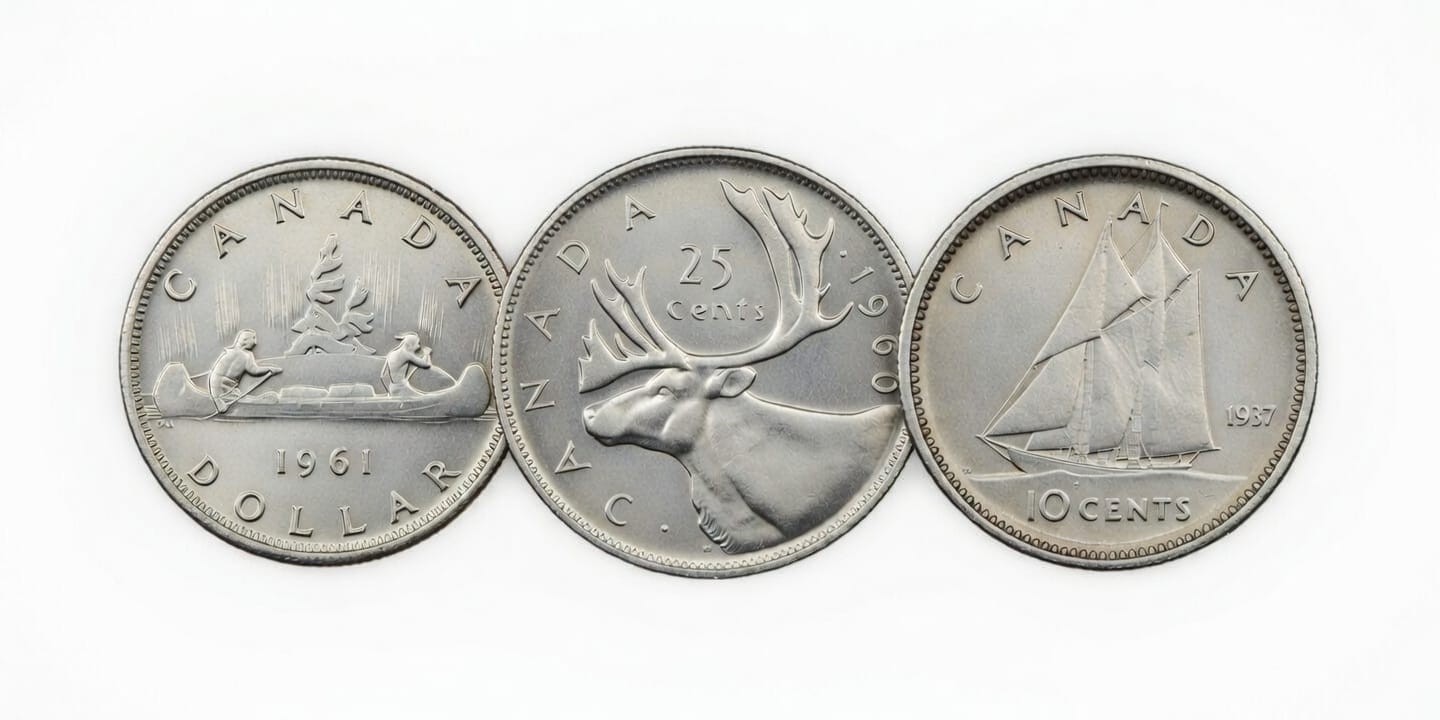
Canadian 80% Silver (1920-1967)
| Coin | Years | Silver Content | Oz per Coin | Oz per $1 Face (CAD) |
|---|---|---|---|---|
| Silver Dollar | 1935-1967 | 80% | 0.60000 oz | 0.60000 |
| 50¢ Piece | 1920-1967 | 80% | 0.30000 oz | 0.60000 |
| Quarter | 1920-1966 | 80% | 0.15000 oz | 0.60000 |
| Dime | 1920-1966 | 80% | 0.06000 oz | 0.60000 |
The advantage of Canadian silver: The silver content is in clean, round numbers. That's 0.6 oz per $1 face value. No decimals to remember.
Canadian 50% Silver (1967-1968 Transition)
| Coin | Years | Silver Content | Oz per Coin | Oz per $1 Face (CAD) |
|---|---|---|---|---|
| Quarter | 1967-1968 | 50% | 0.07500 oz | 0.30000 |
| Dime | 1967-1968 | 50% | 0.03000 oz | 0.30000 |
The 1967 problem: In 1967, the Royal Canadian Mint struck quarters and dimes in both 80% and 50% silver compositions. The coins look identical. Since you can't tell them apart visually, it's safer to value all 1967 quarters and dimes at 50% to avoid overpaying.
Note: Canadian dollars and half dollars were never minted in 50% silver. They went directly from 80% to 100% nickel in 1968.
How Silver Content Is Calculated
Understanding the math helps you verify any calculator and catch dealer errors.
The Formula
Silver Content (troy oz) = Gross Weight (grams) × Purity × 0.03215
The 0.03215 converts grams to troy ounces (1 troy oz = 31.1035 grams).
Example: Washington Quarter
- Gross weight: 6.25 grams
- Purity: 90% (0.90)
- Silver content: 6.25 × 0.90 × 0.03215 = 0.18084 troy oz
Example: War Nickel
- Gross weight: 5.00 grams
- Purity: 35% (0.35)
- Silver content: 5.00 × 0.35 × 0.03215 = 0.05626 troy oz
Example: Canadian Quarter (80%)
- Gross weight: 5.83 grams
- Purity: 80% (0.80)
- Silver content: 5.83 × 0.80 × 0.03215 = 0.15000 troy oz
Calculating Melt Value
Once you know the silver content, calculating melt value is straightforward:
Melt Value = Silver Content (troy oz) × Spot Price ($/oz)
Quick Formulas by Coin Type
90% Silver (per $1 face): Melt Value = Spot Price × 0.715
40% Kennedy Halves (per coin): Melt Value = Spot Price × 0.14792
War Nickels (per coin): Melt Value = Spot Price × 0.05626
Canadian 80% (per $1 CAD face): Melt Value = Spot Price × 0.60
Rather not do this by hand? The MyOunces Junk Silver Calculator does all of this automatically with live spot prices. Enter coins or face value, get instant results.
Current Melt Values
With silver at approximately $77/oz (February 2026):
| Coin Type | Silver Content | Melt Value |
|---|---|---|
| Morgan/Peace Dollar | 0.77344 oz | ~$59.55 |
| 90% Half Dollar | 0.36169 oz | ~$27.85 |
| 90% Quarter | 0.18084 oz | ~$13.92 |
| 90% Dime | 0.07234 oz | ~$5.57 |
| 40% Kennedy Half | 0.14792 oz | ~$11.39 |
| War Nickel | 0.05626 oz | ~$4.33 |
| Canadian Dollar (80%) | 0.60000 oz | ~$46.20 |
| Canadian Half (80%) | 0.30000 oz | ~$23.10 |
| Canadian Quarter (80%) | 0.15000 oz | ~$11.55 |
| Canadian Dime (80%) | 0.06000 oz | ~$4.62 |
The Face Value Multiplier
Dealers and stackers often express junk silver prices as a multiple of face value. At $77 silver:
$1 face of 90% silver = $77 × 0.715 = $55.06 melt value
So the "multiplier" is roughly 55× face value at current prices. When someone says "I'll sell you $100 face at 58× face," they're asking $5,800, which is a premium of about 5% over melt.
See the $1 face value junk silver calculator for the live current value.
Standard Lot Sizes
Junk silver is commonly sold in standard quantities:
US 90% Silver
| Lot Size | Coins (Dimes) | Coins (Quarters) | Coins (Halves) | Silver Content |
|---|---|---|---|---|
| $1 Face | 10 | 4 | 2 | 0.715 oz |
| $10 Face | 100 | 40 | 20 | 7.15 oz |
| $100 Face | 1,000 | 400 | 200 | 71.5 oz |
| $500 Face | 5,000 | 2,000 | 1,000 | 357.5 oz |
| $1,000 Face ("Bag") | 10,000 | 4,000 | 2,000 | 715 oz |
The $1,000 face bag: This is the standard wholesale unit for junk silver. It contains 715 troy ounces of silver in circulated pre-1965 coins and weighs about 55 pounds.
War Nickels
| Lot Size | Coins | Silver Content |
|---|---|---|
| $1 Face | 20 | 1.125 oz |
| $2 Face (Roll) | 40 | 2.25 oz |
| $10 Face | 200 | 11.25 oz |
Calculate current value for any lot size: $1 face, $10 face, and $100 face junk silver calculators.
Buying Smart: Premiums and Red Flags
Understanding Premiums
Junk silver rarely sells at exactly melt value. Expect to pay a premium when buying and receive less than melt when selling.
Typical buy premiums (retail):
- 5-15% over melt: Good deal (calm markets)
- 10-20% over melt: Fair (current volatility)
- 25%+ over melt: High premium, shop around or wait
Typical sell discounts:
- 0-5% under melt: Excellent (calm markets, peer-to-peer)
- 5-10% under melt: Typical dealer price (calm markets)
- 10-15% under melt: Common during volatility
Premium by Coin Type
Not all junk silver carries the same premium:
| Coin Type | Typical Premium | Why |
|---|---|---|
| Roosevelt Dimes | Lowest | Most common, least interesting |
| Washington Quarters | Low | Common, practical |
| Franklin Halves | Low-Medium | Less common than smaller coins |
| Walking Liberty Halves | Medium | Beautiful design, semi-numismatic |
| Mercury Dimes | Medium | Classic design, collector interest |
| Morgan Dollars | High | Strong collector demand |
| Peace Dollars | Medium-High | Less common than Morgans |
| Barber coins | Medium-High | Older, harder to find |
Best value for pure silver: Roosevelt dimes and Washington quarters offer the lowest premiums. If you're stacking purely for silver content, these are your best bet.
Red Flags When Buying
- Premiums over 30%. You're overpaying unless it's a rare date.
- "Cleaned" coins. Cleaning destroys any numismatic value.
- Mixed lots with 40% halves counted as 90%. Always verify composition.
- 1965 or later dates on dimes/quarters. These contain no silver.
- War nickels without the large mint mark. Not all 1942-1945 nickels are silver.
Verifying Silver Content
- The edge test: 90% silver coins have a solid silver edge. Clad coins (post-1964) show a copper stripe.
- The ring test: Silver coins produce a clear, sustained ring when dropped. Clad coins thud.
- The date test: Pre-1965 dimes, quarters, and halves are 90% silver. No exceptions.
- The weight test: A silver quarter weighs 6.25g; a clad quarter weighs 5.67g.
Current Market Conditions (February 2026)
The premium ranges above reflect calmer markets. Right now, silver is anything but calm.
What Happened
Silver peaked above $120/oz in January 2026, driven by industrial demand (solar, EVs, tech), geopolitical tensions, and speculative fervor. It then corrected sharply to the mid-$70s by mid-February, a roughly 40% pullback. This volatility has widened dealer spreads significantly.
What This Means for Premiums
Buying premiums have expanded:
- Normal markets: 5-15% over melt
- Current markets: 10-25% over melt, sometimes higher for small lots
Selling discounts have deepened:
- Normal markets: 0-5% under melt
- Current markets: 5-15% under melt at most dealers
At $77 spot, $1 face of 90% silver has a melt value around $55. But you might pay $65-75 retail (15-30% premium) and only get $45-50 if selling to a dealer (10-20% discount). That's a $15-30 spread per $1 face, requiring significant price movement just to break even on a quick flip.
The Sentiment
Online discussions reflect the tension:
Short-term caution: Volatility, margin calls, and inventory gluts from liquidations have stackers advising patience. Wide dealer spreads mean this isn't an ideal time for quick trades.
Long-term optimism: Fundamentals remain strong. Supply deficits persist, physical demand is robust, and the pullback has cleared speculative froth. Long-term holders see current prices as a buying opportunity despite the elevated premiums.
Practical Advice for Right Now
- If buying: Shop around. Premiums vary widely between dealers right now. Consider peer-to-peer markets (r/Pmsforsale, coin shows) where spreads are tighter.
- If selling: Unless you need liquidity, waiting for premiums to normalize may be wise. Dealer buybacks are particularly weak during volatility.
- If holding: The fundamentals haven't changed. Junk silver's recognizability and divisibility still make it valuable for long-term stacking.
Premiums should normalize as spot stabilizes. J.P. Morgan forecasts an average of $81/oz for 2026, which suggests the market may find its footing by Q2.
Why Eisenhower Dollars Aren't Junk Silver
A common misconception: Eisenhower dollars (1971-1978) are not silver. The large "Ike" dollars that circulated were struck in copper-nickel clad, the same composition as modern quarters.
However, the San Francisco Mint did produce special 40% silver Eisenhower dollars for collectors in 1971-1976. These were sold at a premium and have an "S" mint mark. If someone claims to have silver Ikes, verify the mint mark and be skeptical.
Constitutional Silver vs. Modern Bullion
How does junk silver compare to Silver Eagles or generic rounds?
| Factor | Junk Silver | Silver Eagles | Generic Rounds |
|---|---|---|---|
| Purity | 90% (mixed) | 99.9% | 99.9% |
| Premium | Low (5-15%) | High (15-30%) | Low-Medium (5-15%) |
| Recognizability | Very High | Very High | Medium |
| Divisibility | Excellent | Poor (1 oz only) | Poor-Medium |
| IRA Eligible | No | Yes | Some |
| Counterfeiting Risk | Very Low | Low | Medium |
| Liquidity | Excellent | Excellent | Good |
Junk silver's advantages: Lower premiums, natural divisibility, impossible to counterfeit, instant recognition.
Junk silver's disadvantages: Not IRA-eligible (90% purity doesn't meet the 99.9% requirement), calculations more complex, bulkier to store.
The History: Why 1965?
For over 170 years, US dimes, quarters, half dollars, and dollars were minted with 90% silver. So what changed?
The silver shortage: By the early 1960s, industrial demand for silver was outpacing supply. The price of silver began rising toward the point where the metal in coins would exceed their face value.
The hoarding problem: As silver prices rose, people began pulling silver coins from circulation and hoarding them. By 1964, the US faced a severe coin shortage.
The Coinage Act of 1965: On July 23, 1965, President Lyndon B. Johnson signed the Coinage Act of 1965, eliminating silver from dimes and quarters and reducing the half dollar from 90% to 40% silver.
Johnson's famous quote at the signing: "The new dimes and the new quarters will contain no silver. They will be composites, with faces of the same alloy used in our 5-cent piece that is bonded to a core of pure copper."
The aftermath: As predicted by Gresham's Law ("bad money drives out good"), silver coins disappeared from circulation almost immediately. By the late 1960s, finding a silver coin in your change was rare. Today, it's virtually impossible.
Frequently Asked Questions
What years are US coins silver?
Dimes: 1964 and earlier (90% silver) Quarters: 1964 and earlier (90% silver) Half Dollars: 1964 and earlier (90%), 1965-1970 (40%) Dollars: Morgan (1878-1921) and Peace (1921-1935) are 90% silver. Eisenhower dollars (1971-1978) are NOT silver except for special collector versions. Nickels: Only 1942-1945 "war nickels" with large mint mark above Monticello
How do I identify war nickels?
Look at the reverse (back) of the coin. War nickels have a large P, D, or S mint mark directly above the dome of Monticello. Regular nickels either have no mint mark or have a small mint mark on the obverse near Jefferson's ponytail. This is the only reliable way to identify them. The date alone isn't enough for 1942.
Why are Morgan dollars worth more than their silver content?
Morgan dollars have strong collector demand beyond their silver value. Even common dates in average condition often sell for 20-50% premiums over melt. Key dates and better conditions can be worth many times melt value. Always check before selling Morgans for melt.
Can I put junk silver in an IRA?
No. IRS rules require silver in IRAs to be .999 fine (99.9% pure). Constitutional silver at 90% purity doesn't qualify. For IRA silver, consider American Silver Eagles, Canadian Maple Leafs, or .999 fine bars.
What does "$100 face value" mean?
It means the coins have a combined face value (the denomination stamped on them) of $100. For 90% silver, $100 face contains approximately 71.5 troy ounces of pure silver regardless of the mix of dimes, quarters, and halves.
How do dealers price junk silver?
Two common methods:
- Multiplier: "25× face" means $25 per $1 of face value
- Premium over melt: "10% over spot" means melt value plus 10%
Always calculate melt value yourself to understand what you're paying. The MyOunces Junk Silver Calculator makes this instant.
Is Canadian junk silver a good investment?
Canadian 80% silver offers some advantages: clean round-number silver content, often lower premiums than US Morgan dollars, and strong recognizability in North America. The main downside is less liquidity in the US market compared to US junk silver.
How much does a $1,000 face bag weigh?
A full bag of 90% US silver coins weighs approximately 55 pounds (25 kg) and contains about 715 troy ounces of pure silver.
Should I clean my junk silver?
Never clean coins you might sell. Cleaning destroys any potential numismatic value and can actually reduce what buyers will pay. Junk silver is valued for its silver content, not its appearance.
What's the difference between "junk" and "cull" silver?
"Junk" refers to common silver coins with no collector premium. They're valued purely for metal content. "Cull" refers to heavily worn, damaged, or problem coins that may have reduced silver content due to excessive wear. Culls often trade at slight discounts.
Tracking Your Constitutional Silver
Most portfolio trackers handle junk silver poorly, if at all. They make you enter individual coins or don't understand face value calculations.
The MyOunces Junk Silver Calculator handles all of this automatically:
What it does:
- Live silver spot price, updated every 5 minutes
- US and Canadian coins in one calculator
- Enter by coin count OR face value (they stay synced)
- Shows total melt value, total silver ounces, and total face value
- Melt-to-face ratio so you know your multiplier
- Bag size reference table for $100, $500, and $1,000 face
- CSV export with full calculations
- One-click import to MyOunces portfolio tracking
All purities supported:
- US 90% (Morgan, Peace, Walking Liberty, Franklin, Kennedy 1964, Barber, Washington, Standing Liberty, Roosevelt, Mercury, Barber dime)
- US 40% (Kennedy 1965-1970)
- US 35% (War Nickels)
- Canadian 80% (Dollar, Half, Quarter, Dime 1920-1967)
- Canadian 50% (Quarter, Dime 1967-1968 transition)
No account required. No signup. Enter your coins, see your value.
[Try the Junk Silver Calculator →]
Sources
This guide was compiled from:
- US Mint official specifications and historical records
- Royal Canadian Mint specifications
- APMEX, ITM Trading, JM Bullion, SD Bullion, and Hero Bullion educational resources
- Coinage Act of 1965 (Public Law 89-81)
- Coinflation.com silver content data
- J.P. Morgan silver market forecasts (2026)
- Direct weight and purity verification
Last updated: February 2026